The Broadcasting Mindset
Producing live content requires a radically different mindset from recorded production. In traditional production, a mistake is data that informs the next take. Live, the mistake is part of the broadcast — the audience sees it in real time, and how the team responds defines the perceived quality of the event.
This reality is not a limitation — it is a challenge that demands elevating the standard of preparation to a level that few recorded productions ever reach. Teams that deliver live broadcasting with consistent excellence are the best-prepared teams in the audiovisual sector.
Live, quality is not produced — it is preserved. The real work happened before the broadcast began.
Technical Redundancy as Philosophy
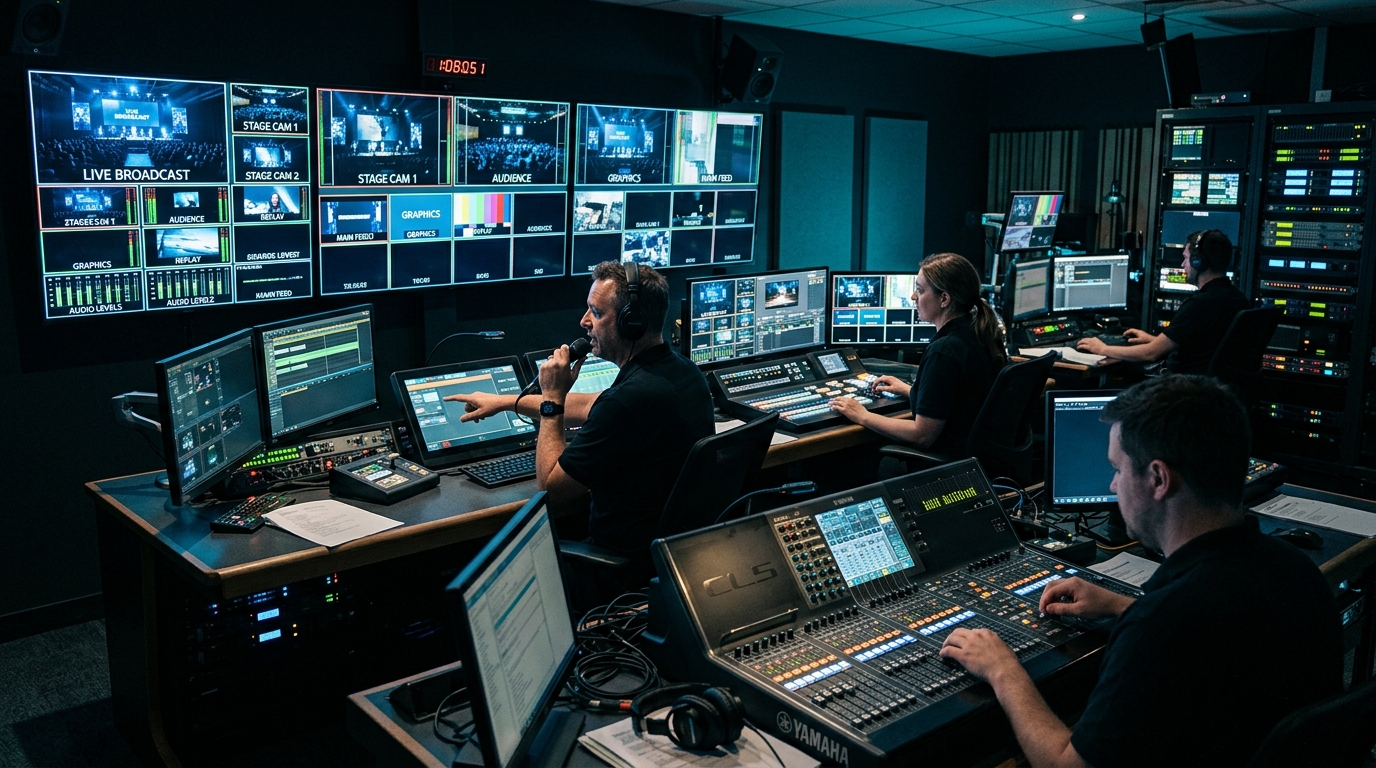
In professional broadcasting, "redundancy" is not a luxury — it is a minimum requirement. Every critical element in the signal chain must have a backup: internet connections from different providers, power sources with UPS systems, backup cameras, redundant audio mixers, duplicate encoders.
Redundancy does not mean irresponsibly doubling the budget. It means precisely identifying which are the critical failure points — those whose failure would stop the broadcast — and ensuring that none of them can fail without an alternative available within seconds.
The Director as a Planned Improviser
The paradox of the live streaming director is that they must plan with obsessive precision while being completely prepared for nothing to go as planned. These two attitudes are not contradictory — they reinforce each other.
Planning defines the parameters within which improvisation is safe. A detailed rundown, clear communication between all roles on the team, a technical rehearsal before the event: none of this eliminates the need to improvise, but it ensures that when improvisation is necessary, the director makes informed decisions in seconds rather than reacting in panic.
The Real-Time Audience as a Variable
In streaming, the audience is not a passive viewer who will watch the video when it is ready — they are an active participant in real time. Their comments, reactions, and level of engagement are live data that can inform how the broadcast develops.
Producing for a real-time audience requires narrative fluency: the ability to maintain the arc of the event while responding to what is happening in the moment. A comment that goes viral, a question worth incorporating, a spontaneous moment the camera captured without planning — in the hands of an agile team, these elements become the most memorable moments of the broadcast.
Precision in preparation. Flexibility in execution. Total presence in the moment. Those are the three pillars of a well-produced live stream.